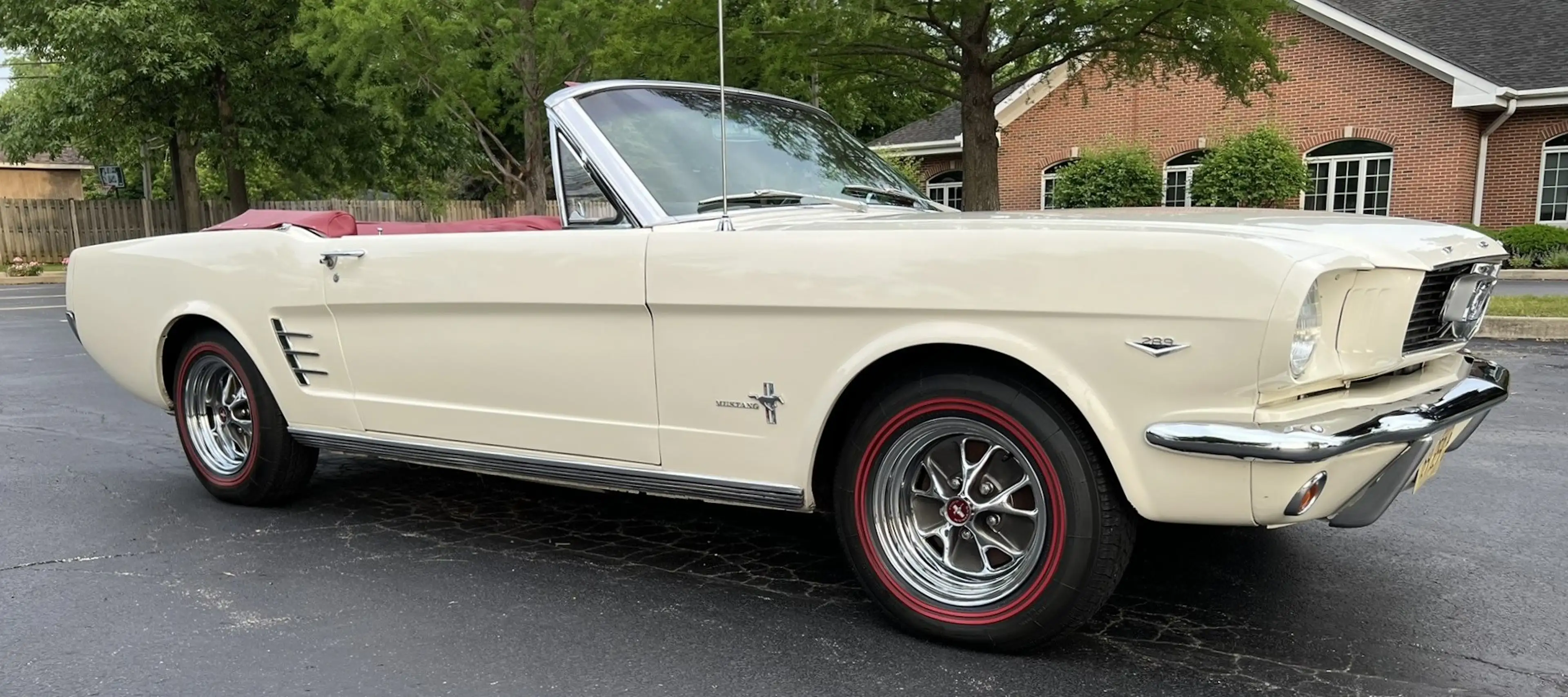
1966 Ford Mustang Convertible




Ended Aug 07, 2025 at 7:12 PM UTC

Recommended services

Description
OFFERED WITHOUT RESERVE
Ford swiftly revolutionized the automobile industry with the introduction of the Mustang at the New York World’s Fair in April 1964, captivating a young generation of enthusiasts and generating the sale of more than 120,000 '65 Mustangs by August. Body styles included a two-door Hardtop, Convertible, and (beginning in September) Fastback 2+2, all of which were offered with a base 120-horsepower, 170 cu-in straight-six or a slew of optional engines up to a 289 HiPo V8.
Ford offered so many options — it boasted over 70 of them, not including the 21 available colors — that it introduced only minor changes for the second full year of production. The most notable update on the 1966 Ford Mustang was the introduction of a new grille design featuring a floating Mustang emblem. Additionally, the side scoops were redesigned, new wheel covers were introduced, and the interior was updated with a new five-gauge instrument cluster and optional convenience features.
Under the hood, the ’66 Mustang again offered a range of engine choices, and the original owner of this two-door Convertible selected the 289 cu-in V8 with two-barrel carburetor and optional C4 Cruise-O-Matic three-speed automatic transmission. This two-owner ’66 Mustang shows 60,415 miles, believed to be original.
Highlights
Powered by a 289 cu-in V8 rated at 200 hp and 282 lb-ft of torque
Three-speed automatic transmission
The chassis number (6F08C332957) decodes as:
6 – 1966 model year
F – Ford
08 – Convertible
C – 289 cu-in V8 2 bbl
332957 – Sequential production number
The data plate decodes as:
Body: 76A – Two-door convertible
Color: M – Wimbledon White
Trim: 25 – Red Crinkle vinyl on the seat bolsters and side panels with Red Rosette vinyl seat inserts
Date: 028M – December 28, 1965 build date
DSO: 41 – Chicago District Sales Office
Axle: 6 – 2.80:1 rear axle ratio
Trans: 6 – C4 three-speed automatic transmission
Repairs and repaint in 1975 included:
New original factory bumpers
New original factory body panels and additional parts
Refinished in original Wimbledon White paint
Features
Original black soft top
Later-model, wood-rimmed steering wheel
AM radio
140 mph speedometer
Upgraded 14-inch Mustang sport wheels
Coker Classic P195/75R14 redline tires
Known Imperfections
Minor paint chips under driver’s side rearend chrome accent piece
Rust on underside of floor pans
Rear window was replaced
Driver’s seat cover is split in two places
Small crack on underside of dashboard on passenger side
Small nick in glovebox paint
Included
Original spare tire mounted on original wheel
Convertible top boot cover
Carpeted Mustang floor mats
Ignition and trunk keys
Original wheels with tires
Ownership History
The Illinois owner of this 1966 Ford Mustang Convertible bought it from the original owner 50 years ago. The seller says, “I purchased this car in 1975 from a good friend and co-worker. He was the original owner of the car, and therefore I am 99 percent sure that the mileage (60,415) is original. When I purchased the car, it had minor damage to both the front and rear end; it was in a line of cars at a stop light when they were rear-ended. In the process of repairing the car, I decided to have the bumpers and damaged body panels replaced with genuine Ford parts that were available at that time. All the body panels were replaced except for the left front fender, the doors, and the trunk lid. It had the original paint, but I also had it repainted. Since then, I have driven it only a couple hundred miles per year in nice weather and to local car shows. The original cloth top does not leak, but the edges are frayed due to its age, so it should be replaced if this is to be a daily driver. The car is totally rust free except the floor pans on the underside of the car (interior floors are solid.”
All auction listings on Hagerty Marketplace are created using information provided by the seller. The Marketplace team and the seller have reviewed all information for accuracy to the best of their abilities. Bidders are ultimately responsible for conducting their own due diligence before placing a bid, including verifying details, condition, registration requirements, and compliance with applicable laws. For any questions or additional information, contact the seller.


